

There is a misconception that floats around every time the Federal Reserve makes a move, and honestly, I get it. The headlines make it sound so straightforward. The Fed cuts rates, mortgage rates go down, buyers rush in, the market opens up. If only it were that simple.
Here’s what I want you to actually understand, because this is the kind of thing that affects whether you make a smart move this year or sit on the sidelines waiting for something that may never arrive the way you expect.
Let me be direct: just because the Federal Reserve lowers its interest rates does not mean your mortgage rate is going to respond the same way. These are two completely different mechanisms, and confusing them leads to a lot of frustration for buyers who keep waiting for a signal that never comes.
The Federal Reserve controls the federal funds rate, which is the rate banks charge each other for overnight loans. The Fed does not directly cut mortgage rates, 10-year Treasury rates, or the rates on corporate debt. Mortgage rates are long-term instruments, and they behave accordingly. Those longer-term borrowing costs tend to move with the 10-year Treasury yield, which rises and falls based on expectations for economic growth and inflation in the years ahead.
So what does that mean in plain language? Even when the Fed is actively cutting, the bond market may be telling a completely different story. And the bond market usually wins.
Here is the part that feels counterintuitive, and it’s one of the most important things to understand right now. A healthy job market is genuinely good news for the economy, but it is not good news for anyone hoping mortgage rates will drop quickly.
Redfin chief economist Daryl Fairweather put it plainly: “Is inflation improving? Is the labor market getting weaker? If the answer to either is yes, then mortgage rates would fall.” That tells you everything. The conditions that bring mortgage rates down tend to be the same conditions that reflect economic pain. The job market hasn’t plummeted like many expected it to, and that’s actually worth celebrating on a human level. But it does mean we are less likely to see the dramatic rate drops some buyers are holding out for.
Redfin’s chief economist noted that inflation will matter more to rates than leadership changes at the Fed or however many short-term rate cuts it makes. “If a new Fed chair cuts rates now, but there’s still inflation, market traders would assume that the Fed will have to increase rates later on to make up for that misstep.” The market is always thinking several moves ahead.
If you want to understand where mortgage rates are headed, stop watching what the Fed announces and start paying attention to inflation expectations. This is where the real action is.
Mortgage rates are heavily influenced by inflation expectations and economic growth. If inflation rises while growth slows, investors often demand higher yields on bonds, which pushes mortgage rates upward. This is one of the reasons good economic news can actually be complicated for buyers. Strong growth and persistent inflation expectations keep rates elevated even when the Fed is in a cutting cycle.
According to Veros Real Estate Solutions’ Q1 2026 update, even if the Fed implements rate cuts, they are expected to be few and not likely to impact mortgage rates in a significant way. The stickiness of inflation in areas like shelter and food is a real factor, and it’s keeping upward pressure on the rates buyers care most about.
Here is the perspective I want you to hold onto, because it matters. Yes, rates are not at 5% and they are probably not getting there anytime soon without some economic turbulence. But we have come a long way.
Since the start of 2023, the average 30-year fixed mortgage interest rate ranged between 5.98% and 7.79%, according to Freddie Mac. As of early March 2026, the latest weekly average 30-year fixed rate reached 6%. That bottom of the range, right around 6%, represents a real improvement for buyers who were staring down 7.5% or higher not that long ago.
The 30-year fixed-rate mortgage averaged 6.11% as of March 12, 2026, according to Freddie Mac. Is it the rate anyone dreamed about during the pandemic? No. But for borrowers with strong credit, the lowest weekly offers tracked by Bankrate were running around 5.6% as of early 2026. The rate you see in a headline is rarely the rate you will actually get, especially if you have prepared well.
The buyers and sellers I work with who are winning right now are the ones who have stopped waiting for a perfect headline and started working with the actual market in front of them.
Rebekah Scott, director of investment real estate at Atlas Real Estate, said it well: “Don’t try to time the bottom. If you find a home that works and a rate near 6%, that’s a solid position by any historical standard.” That is exactly the conversation I have with my clients. Waiting for rates to drop into the 5s could mean sitting out another full year or more while home prices quietly continue to move.
Overall, 2026 is shaping up to be a mild improvement over 2025. Assuming all goes as expected, buyers will gain slightly more purchasing power due to lower mortgage rates, and sellers won’t see a significant decline in home prices. That is a reasonable foundation to work from.
The misunderstanding that any positive economic news equals lower rates has cost a lot of buyers time and opportunity. The relationship is more nuanced than that, and honestly, having someone in your corner who understands the difference can change the whole outcome of your home search.
If you have been waiting on the sidelines trying to make sense of economic headlines, let’s talk. I help buyers and sellers cut through the noise and make decisions grounded in what is actually happening in the market, not what the news cycle wants you to believe. Reach out today and let’s figure out what the right next step looks like for you.
If you have any real estate needs, I’m the realtor for you! You can always reach me at tracyYchan@gmail.com or my cell at 973-476-8097.
If you haven’t already, remember to subscribe to our newsletter and get real estate updates in your inbox!
There is a new federal anti‑money laundering rule that directly targets certain all‑cash and non‑financed home purchases, and it is now in effect. The rule is aimed at stopping bad actors from hiding illegal money in residential real estate, especially when properties are bought through entities or trusts with no traditional financing.
This matters for regular buyers and sellers too, because it changes what has to be disclosed and who will be willing to do all‑cash deals going forward.
The rule mainly applies when a residential home is bought without a traditional bank loan and the buyer is a legal entity or a trust, not an individual using their own name. Think LLCs, corporations, partnerships or trusts buying houses, condos or similar residential properties with cash, hard money or private money.
These kinds of deals were often used for privacy or asset protection, but they are now treated as reportable events that must be documented for the U.S. Treasury’s Financial Crimes Enforcement Network, also known as FinCEN.
Under the new rule, a closing or settlement agent, usually the title company or closing attorney, must collect detailed information on the “beneficial owners” behind the entity or trust and submit a Real Estate Report to FinCEN within a set time after closing. This includes names, addresses, Social Security or taxpayer identification numbers and other identifying details for the real people who ultimately own or control the buying entity.
Although real estate agents are not the ones filing the reports, NAR is stressing that we need to understand the rule so we can prepare our clients and avoid last‑minute surprises at the closing table.
For sellers, this rule may reduce some of the looser, more anonymous cash investor activity that has been present in certain markets.
Some all‑cash buyers who used entities or trusts mainly for secrecy may now think twice if they have to reveal their ownership details to a federal database, even if they are not doing anything wrong.
That could mean slightly fewer “mystery” cash offers, but it may also shift the buyer pool toward more transparent, well‑documented purchasers who are comfortable providing their information.
If you are a legitimate buyer planning to purchase with cash through an LLC or trust, this rule will probably feel like a hassle at first.
You will need to be clear and organized about where your funds come from and who the true owners are, because title companies and closing attorneys are being told not to close these deals unless all required information has been collected.
It is easy to feel like you are “under investigation,” even when you are simply trying to buy a home for privacy or estate planning reasons, and that emotional piece is important to acknowledge.
Many buyers have used entities or trusts to keep their names out of public records for reasons like safety, high‑profile jobs or estate planning.
The government is not banning this, but it is saying, “If you are buying non‑financed residential property this way, we still need to know who you are behind the scenes.” Some legal and tax professionals are already outlining compliant structures that balance privacy with the new reporting requirements, but they all come with more documentation and planning than before.
FinCEN has been clear about its main concern. Criminal organizations, corrupt officials and other bad actors often use all‑cash purchases through shell companies or trusts to move and hide illegal money, especially when there is no bank involved to run anti‑money‑laundering checks.
The agency estimates that hundreds of thousands of transactions a year fall into this non‑financed residential category, and they see it as a major weak spot in the financial crime system.
By creating a secure, non‑public database that tracks real owners on these deals, FinCEN hopes to deter abuse and make it easier to follow the money when something looks suspicious.
In practice, this rule adds steps, questions and paperwork for everyone involved in affected cash deals.
Closing and settlement agents now have new forms to complete, new deadlines to meet and new risks if they get the reporting wrong or close without all of the required data.
For buyers, especially those using business entities or trusts, it means gathering personal information for each beneficial owner early, sharing it with the closing team and understanding that your transaction is now part of a federal reporting system, even if none of that shows up in public records.
If you are thinking of buying with cash, especially through an entity or trust, the key is not to panic, but to prepare. This rule does not say cash is bad or that entities are illegal. It says, “We need transparency about who is behind the money.”
Going in with the right expectations, your ownership structure clearly planned and your documents organized can turn this from a last‑minute crisis into just another box you check on the way to owning a home or investment property.
If you are a seller wondering how this might impact the cash buyers who show up on your listing, or a buyer planning to purchase with cash through an LLC or trust, let’s talk before you get too far into the process. I can help you understand how this new rule fits into your specific situation, coordinate early with your title company or closing attorney, and connect you with legal and tax professionals so you can stay compliant while still moving forward with your real estate goals.
If you have any real estate needs, I’m the realtor for you! You can always reach me at tracyYchan@gmail.com or my cell at 973-476-8097.
If you haven’t already, remember to subscribe to our newsletter and get real estate updates in your inbox!
Right now, a lot of people want to move, but feel like they cannot. According to recent survey data, about 35% of homeowners say they cannot afford to give up their current low mortgage rate, another group says there are no affordable homes nearby, and some worry they cannot afford the capital gains tax if they sell.
That “stuck” feeling is real, and it is a big reason why we still see low inventory, even with more buyers peeking back into the market.
Here is the hopeful news. Redfin reports that the average 30‑year mortgage rate has dropped to around 6.01%, the lowest level since fall of 2022, which has pushed the median U.S. monthly housing payment down about 2.6% compared with a year ago. Wages are also nearly four% higher than they were last year, which means a typical buyer’s income is doing a bit more work against today’s prices.
Put simply, the same house now costs a little less per month than it did a year ago, and many buyers have a slightly stronger paycheck to meet that payment.
Even with this improvement, many buyers are still parked on the sidelines, hoping rates will fall even further. Surveys show that a big share of homeowners do not feel comfortable buying again unless rates drop below 6%, and some say they are holding out for rates closer to 4% or even 3%, which may not be realistic anytime soon.
Redfin’s data also shows that purchase applications and pending sales are still soft, which tells us that lower rates alone have not been enough to flip the market back into full “rush” mode.
If you already own a home with a 3% or 4% mortgage, it can feel almost impossible to walk away from that payment and take on something near 6%, even if you truly need more space or a different location.
Economists often call this the “lock‑in effect” because those low existing loans keep owners frozen in place, which limits the number of homes coming on the market. That is a big reason buyers still see tight inventory and feel there are not many affordable options close to where they live and work.
Here is where it helps to look at the numbers instead of only the headlines.
A drop in mortgage rates from the high sixes into the low sixes can add a few percentage points of buying power while keeping your payment roughly the same, and some estimates show that buyers can afford roughly 2-3% more “house” after a quarter‑point rate drop.
When you layer on a 4% raise in income compared with last year, that effect gets a little stronger, especially if you have also paid down other debts or saved more for a down payment. It may not suddenly turn every market into a bargain, but it can move you from “no way” to “this is tight but doable,” which is a meaningful shift.
If you are hoping to buy this year, the current moment is a mix of opportunity and caution.
On the opportunity side, you are looking at the lowest mortgage rates in more than three years, softer monthly payments than a year ago, and a market that is less frantic than the bidding‑war peak of a few years back.
On the caution side, home prices are still near record highs in many areas, and supply is still constrained by owners who do not want to give up their ultra‑low loans, so you need to be realistic and prepared, not just hopeful.
This is the big question everyone is asking.
Some buyers will always wait for “one more” rate drop, but economists and housing analysts are warning that timing the market perfectly is almost impossible. If rates fall much further, buyer demand could surge again, which might push prices or competition back up, eating away some of the benefit of the lower rate.
A more helpful question is whether a home you can buy today at current rates fits your budget, your life and your likely plans for the next five to seven years, instead of chasing a perfect scenario that may never arrive.
In this moment, the most confident buyers are the ones who know their numbers and their “why.”
That means understanding what you can truly afford every month after you factor in taxes, insurance and maintenance, not just the mortgage itself. It also means being clear about why you are moving, whether it is more space, a shorter commute, better schools, or getting out of rising rents, so you are not paralyzed by the idea of giving up a hypothetical lower rate.
If you are wondering whether to jump in now or wait for rates to drop further, let’s run through your specific numbers and goals together instead of guessing. I can connect you with trusted lenders, break down realistic monthly payments at today’s rates, and help you spot the right opportunities in your price range so that when you decide to move, it feels like a thoughtful step toward your future and not just a reaction to the latest headline.
If you have any real estate needs, I’m the realtor for you! You can always reach me at tracyYchan@gmail.com or my cell at 973-476-8097.
If you haven’t already, remember to subscribe to our newsletter and get real estate updates in your inbox!
An inspection report helps buyers decide if the condition and price of a property make sense for them, not just for today but for the next few years of living there. This idea lines up with how many real estate pros describe inspections as a key tool for making an informed decision, not a quick pass or fail.
A good report gives you options. It shows you whether to move ahead as planned, ask for repairs or credits, or walk away if the issues are too big for your comfort level. The report is there to give you leverage and clarity during negotiations.
One of the biggest myths is that a house can “fail” an inspection. In reality, an inspection is not a test, it is a snapshot of the home’s current condition so you can decide how to move forward. Many inspection experts remind buyers that there is no such thing as a perfect home and that inspectors are paid to find issues, big and small.
If your report shows a long list of items, it does not automatically mean the home is a bad buy. It usually means the inspector is doing their job and documenting everything so you are not walking in blind. From my decades-long experience in real estate, I find that every inspection finds something that needs attention, which is completely normal.
Seeing pages of notes and photos can be overwhelming, especially for first‑time buyers. It can feel like the house is falling apart, even when many items are small or cosmetic. These reports are actually written in careful, sometimes scary‑sounding language because inspectors need to protect themselves and be thorough.
The key is to sort issues into categories. Some items are urgent safety or structural concerns, some are maintenance you can plan for, and others are minor annoyances you can live with for a while. I can go through the inspection list with you to help you tell the difference.
Your inspection report gives you choices, not orders. It can open the door to renegotiating the price, asking the seller to make certain repairs, requesting a credit at closing, or in some cases deciding to walk away. Buyers who understand this are less likely to panic and more likely to use the report as a smart bargaining tool.
Sometimes sellers will agree to fix major safety or system issues. Other times they may prefer to offer a credit so you can handle repairs your way after closing. And in a strong seller’s market, they may say “no repairs” and let you decide whether you still want the home. The important thing is that the report gives you a basis for that conversation.
It helps to remember that even brand‑new homes can have a list of findings. Experienced inspectors often say that “every home has issues and every issue is fixable,” it is just a matter of cost, urgency and your comfort level. That perspective keeps you from walking away from a solid home just because the report is detailed.
Instead of asking “Is this house perfect,” a better question is “Is this house worth it for me, knowing what I now know.” With the right guidance, your inspection turns into a roadmap for future maintenance and improvements rather than a list of demands you must throw at the seller. That is how you stay in control of your decision and your peace of mind.
My buyers never have to decode that report alone. I walk through the findings with you, help you prioritize what matters most, and craft a thoughtful response to the seller. Together, we focus on safety, big‑ticket items, and your comfort level so you can decide whether to proceed, renegotiate, or walk away with peace of mind.
If you have any real estate needs, I’m the realtor for you! You can always reach me at tracyYchan@gmail.com or my cell at 973-476-8097.
If you haven’t already, remember to subscribe to our newsletter and get real estate updates in your inbox!

There are many first‑time homebuyer mistakes that can turn an exciting season of life into something stressful and overwhelming. I don’t say that to scare you, but to remind you that being informed is one of the best ways to protect your future self. When you understand where other buyers went wrong, you can move more confidently and actually enjoy the process of buying your first home.
A lot of new buyers talk to one lender, get one quote, and stop there. The problem is that different lenders can offer different interest rates and fees, and even a small difference in the rate can cost you thousands over the life of your loan.
Taking the time to compare a few options means you aren’t leaving money on the table before you even get the keys.
Many people still believe they must have a full 20 percent down payment or they can’t buy a home at all. In reality, there are loan programs with much lower down payment options, especially for first‑time buyers and certain income ranges.
That doesn’t mean you should drain every dollar you have just to hit a number, it means you should learn what is realistic for your situation instead of letting myths hold you back.
Another big mistake is waiting for the “perfect” interest rate or the “perfect” price, and never actually making a move. Markets go up and down, and no one can predict the exact bottom or top, not even the experts.
It is much more helpful to focus on whether the payment is comfortable, the home fits your life, and your job and plans are stable enough to make owning make sense right now.
Stretching your budget too far is a painful mistake, especially with today’s prices and rates. If your mortgage payment already feels tight on closing day, it is going to feel even heavier once repairs, taxes and insurance show up.
I want you to have a home you love, but I also want you to have a life outside of your mortgage, with room to breathe and enjoy your home instead of resenting it.
Many first‑time buyers empty their savings to cover closing costs or to impress the lender with a bigger down payment. This is a common mistake because it leaves you without a rainy‑day fund when real life happens, like a job change, car repair or surprise home expense.
Keeping money aside for emergencies is not a luxury, it is what lets you sleep at night once you own the home.
It is easy to think only about the principal and interest payment and overlook property taxes, homeowners insurance, utilities, HOA fees and maintenance. Those “extras” add up and can be the difference between a home that feels comfortable and one that feels like a burden.
When we work together, we will look at the full picture so there are fewer surprises after closing.
House hunting before you are pre-approved is like shopping without knowing what is in your wallet. Without a clear price range from a lender, it is easy to fall in love with homes that are out of reach or miss out because another buyer was already fully ready.
A strong preapproval gives you clarity, confidence and a better position when you are ready to write an offer.
Buying a home is emotional, especially your first one. But if emotions lead the way, it is easy to overlook major issues like location, repairs, or true affordability. I am here to support how you feel and also gently bring you back to the facts, so the home you love on day one is still a good decision for you years from now.
You don’t have to tackle all of this alone. My job is to help you avoid these first‑time buyer mistakes by slowing things down, asking better questions and sharing resources that match your budget and goals. I want you to enjoy this process, not feel overly stressed or financially burdened by decisions you didn’t fully understand at the time.
If you have any real estate needs, I’m the realtor for you! You can always reach me at tracyYchan@gmail.com or my cell at 973-476-8097.
If you haven’t already, remember to subscribe to our newsletter and get real estate updates in your inbox!

We are in a big moment for real estate. Not just with prices and interest rates, but with where and how you even see homes for sale.
Recently, a federal judge rejected Compass’s request to block Zillow’s “private listing” rule, and it has stirred up a lot of strong opinions in our industry. Some people are calling this a win for consumers, brokerages, agents and the real estate industry. Others feel that Zillow is not helping consumers or real estate agents, and is really trying to monopolize the market instead.
Here is what is going on, in real‑world terms, and why it matters to you if you are thinking about buying or selling.
In this case, Compass argued that Zillow has too much power in the online home search world and that its rules are unfair. They wanted the court to stop Zillow from enforcing its “Listing Access Standards,” which basically say that Zillow will only show homes that are on the MLS within one day of being marketed to the public.
Compass uses a strategy where some homes are first marketed privately to their own network before they hit the open market. They see that as creating buzz and giving their clients an edge. Zillow sees that as hiding inventory from regular buyers.
The judge took a hard look at Compass’s request and said no. In a 50 page opinion, she said Compass had not shown enough evidence that Zillow has monopoly power in online home search or that this rule would cause Compass the kind of harm that justifies an emergency block.
Even though Zillow may have a big share of traffic, the judge pointed out that agents and brokerages still have other ways to market listings outside of Zillow. So for now, Zillow can keep enforcing its rule while the larger lawsuit continues.
Zillow, of course, called the ruling a clear victory and says their stance is about fairness. In their words, everyone deserves equal access to the same real estate information at the same time, and private “vault” listings hurt consumers and small brokerages.
Compass, on the other hand, says this is not a loss, that the lawsuit continues, and that they have an obligation to protect their agents from what they see as Zillow’s market power.
So is this good or bad for buyers and sellers? The answer is a little bit of both, and that is where real insight matters more than headlines.
On one side, Zillow’s rule sounds very consumer‑friendly. If a home is being marketed publicly, it should be easy for you to find, not hidden behind a “black box” that you can only unlock by going with one specific brokerage. In markets like Austin, Los Angeles and New York City, Compass has hundreds of “Private Exclusives” that you simply will not see on big portals like Zillow or Realtor.com unless you are already in their ecosystem. That can create FOMO for buyers, and it can make it harder to feel confident that you have truly seen all your options. From that perspective, a rule that discourages off‑MLS public marketing can help keep the playing field a little more level.
On the other side, private or “coming soon” style marketing can give some sellers and agents a sense of control and exclusivity. For a luxury seller who values privacy, or for a family testing the waters before a full launch, that softer first step can feel very attractive. Some agents also believe that these private phases can generate stronger buzz and sometimes stronger offers. The concern many in the industry have is that if big portals like Zillow get to decide which listings are “in” and which are “out,” they may gradually shape consumer behavior in a way that concentrates more power in their hands. Even though the judge did not see enough evidence of monopoly power right now, many people still worry about where this trend could lead.
For you as a consumer, the key takeaway is this. No website shows you the whole market story.
Zillow is powerful, but it is not the entire world. Compass has a big footprint and a lot of private inventory, but that does not mean every opportunity is hiding behind a login. Other portals, local MLS feeds, brokerage sites and agent networks all play a role. The real risk is when buyers and sellers trust only one channel and assume that what they see on one screen is the full truth.
This ruling also reminds us that there is a tension right now between transparency and exclusivity.
Some companies want to bring every listing to every screen as quickly as possible, in the name of fairness and open access. Others want to carve out private spaces where their clients get something “extra,” like early or off‑market access.
Neither side is fully right or wrong. What matters is how it impacts your ability to make informed decisions and protect your own interests.
If you are a buyer, this is why working with a trusted agent still matters so much. A good agent will not only set you up on the major portals. They will plug you into local MLS alerts, brokerage networks, “coming soon” opportunities and even quiet conversations about homes that are not online yet. That way, you are not relying on any one platform to tell you what is out there. In a world where some listings are hidden on purpose and others are restricted by platform rules, having someone whose job is to uncover options for you is a huge advantage.
If you are a seller, the question is how you want your home to show up in that landscape. Do you want maximum exposure right away, where your home is launched on the MLS and all the major portals at once? Or does your situation call for a more controlled, phased approach that starts quietly and then goes broad? The answer depends on your goals, your privacy needs and your timeline. The important thing is that you understand how portal policies, brokerage strategies and MLS rules interact so that your listing is not accidentally limited in ways you did not intend.
For me, this case is a reminder that the online home search world is still young and still evolving. Rules will change. Lawsuits will come and go. Big companies will push and pull for more control. In the middle of all that are real people trying to find a place to live, build wealth, and make smart choices for their families.
My team and I will keep an eye on how this lawsuit unfolds and how platforms like Zillow, Compass and others continue to shape the way listings are shared. We will update our blogs as things change, and we will always try to cut through the noise to tell you what these decisions really mean for you. You deserve clear access to information, but you also deserve a guide who can help you read between the lines.
If you have any real estate needs, I’m the realtor for you! You can always reach me at tracyYchan@gmail.com or my cell at 973-476-8097.
If you haven’t already, remember to subscribe to our newsletter and get real estate updates in your inbox!

The U.S. has a serious housing crisis—but for the first time in a while, there’s real movement in Washington that could actually help everyday buyers and renters, not just headline statistics.
Recently, the House of Representatives passed a bipartisan housing package called the Housing for the 21st Century Act by a huge 390–9 vote, and now it’s headed to the Senate. I’m happy about this because it’s one of the few times both sides of the aisle are agreeing that we need more homes, more affordability, and fewer hurdles for people who simply want a stable place to live.
The National Association of REALTORS® has been strongly backing this bill, and they’ve been clear: we’re short roughly 5 million homes nationally, and the average first‑time buyer age has climbed to about 40. That is not what “starter home in your 20s or early 30s” is supposed to look like.
This package isn’t just another speech or slogan—it’s designed to make it faster and cheaper to build homes in real communities where families live and work. A few key ways it aims to do that:
It helps communities tackle restrictive zoning and red tape that slow down new construction and keep prices artificially high.
It streamlines environmental and permitting reviews so good, safe projects don’t sit in limbo for years while costs climb.
It modernizes long‑standing federal housing programs, like HOME and Community Development Block Grants, so local governments can respond to today’s affordability realities instead of yesterday’s.
It supports more “missing middle” housing—townhomes, small multifamily buildings, and modest condos that are often the true starter homes for younger buyers.
For younger buyers who feel priced out, this isn’t about making housing “cheap.” It’s about giving you more options—more starter homes at realistic price points, more neighborhoods you can consider, and fewer bidding wars that spiral out of control. As more supply comes online, it can ease the pressure that’s been driving both home prices and rents higher for years.
Right now, more than 75% of homes in many markets are considered unaffordable to the typical household, and a lot of Americans are roughly $30,000 short of what it takes to comfortably buy a median‑priced home. That’s a crushing gap, especially if you’re just starting your career, paying off student loans, or trying to raise a family.
This bipartisan housing package is a step toward closing that gap by:
Encouraging more builders to focus on entry‑level and “missing middle” homes instead of only luxury product.
Making it easier for local banks and lenders to support smaller, community‑focused housing projects.
Pushing federal programs to better support first‑time and lower‑ to middle‑income buyers, not just those already deep into the market.
Will this bill magically fix everything overnight? No. But if it becomes law, it can shift the trajectory—from a market where many younger buyers feel they’ll “never” own a home, to one where starter homes are at least within reach with reasonable planning and support. That’s why I’m genuinely happy about this development.
At the community level, more flexible zoning, more support for smaller‑scale development, and refreshed federal programs can mean:
More starter‑friendly homes in neighborhoods near jobs, schools, and transit—not just far‑flung new construction.
Better use of existing land—think duplexes, triplexes, and townhomes instead of only one house per large lot.
More private and public investment in affordable and workforce housing, especially when tax credits and local grants can be leveraged together.
This isn’t just about selling houses; it’s about stabilizing families, building generational wealth earlier in life, and giving people more control over where they put down roots.
The House has done its part; now the bill moves to the Senate, where the details will be debated and blended with the Senate’s own housing package. There’s still work to do, and there will almost certainly be negotiations and changes before anything lands on the President’s desk.
My team and I will keep a close eye on how this bipartisan housing package progresses and what final version emerges. As things evolve, we’ll update our blog with what it really means for you:
If you’re trying to buy your first place sooner rather than later.
If you own already and are wondering how added supply might impact your equity and long‑term plan.
If you’re a renter hoping for relief from rising rents and a clearer path to being an owner one day.
We have a large housing crisis in the USA—but for the first time in a long time, there is meaningful, bipartisan momentum aimed at boosting supply and improving affordability. I’m happy about that, and I’m hopeful that more communities will soon be able to afford true starter homes and overcome barriers to homeownership at a younger age.
If you have any real estate needs, I’m the realtor for you! You can always reach me at tracyYchan@gmail.com or my cell at 973-476-8097.
If you haven’t already, remember to subscribe to our newsletter and get real estate updates in your inbox!
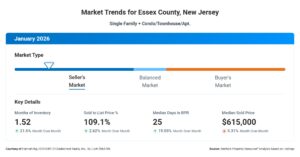
Essex County’s market is still firmly in seller territory, but January brought a subtle shift that creates fresh openings for both buyers and sellers who know how to read between the lines.
Months of inventory in Essex County is sitting at just 1.52, which is extremely low and signals that well‑priced homes are still getting snapped up quickly. Homes are also closing at a strong 109.1% of list price on average, meaning buyers are routinely offering above asking to win. With a median of 25 days on market, properties are not lingering—motivated buyers are acting decisively when something good hits the MLS.
For homeowners, this backdrop means you still have the upper hand: limited supply, strong demand, and buyers who are willing to stretch if the home shows well and is priced strategically.
Here’s where the story gets more nuanced: the median sold price slipped from about $650,000 in December to $615,000 in January. That drop doesn’t mean the market is crashing. Instead, it suggests buyers pushed back a bit on pricing at the end of the year, and more mid‑range homes likely made up January’s closed sales. At the same time, months of inventory climbed 21.6% month over month, which means there are simply more options on the shelf than there were a few weeks ago.
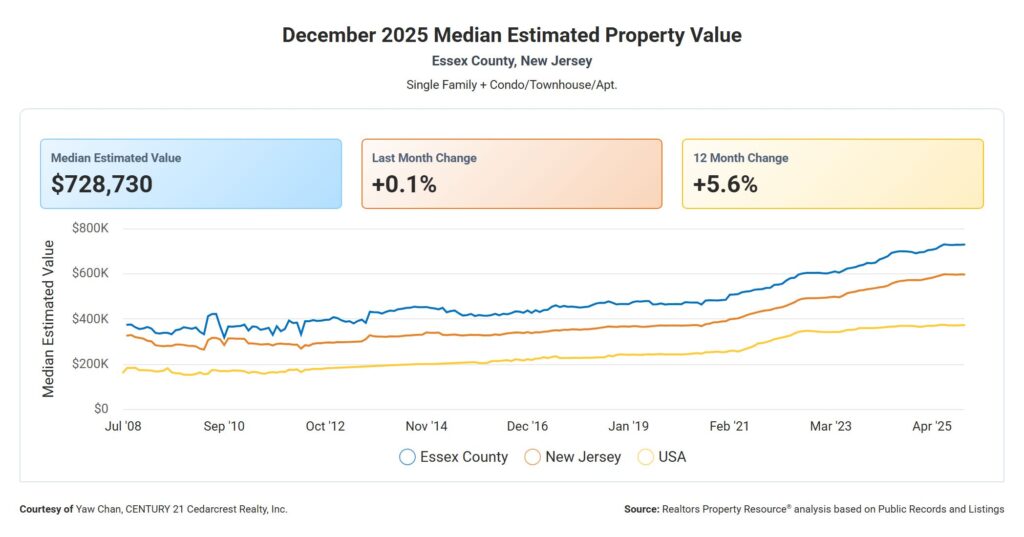
Zooming out, Essex County property values are still up about 6.7% over the past 12 months, so the longer‑term trend is one of steady appreciation, not decline. This combination—slightly softer month‑to‑month prices but strong year‑over‑year gains—is exactly what a “cooling but still competitive” market looks like (RPR).
For buyers who felt completely shut out in 2021–2023, this version of a seller’s market is more workable. The small dip in median sold price and the increase in inventory give you a bit more breathing room to compare homes instead of writing an offer on the driveway at the open house. On top of that, national and New Jersey forecasts suggest mortgage rates in 2026 will generally hover in the low‑6% range, with potential modest declines if inflation keeps easing.
At the national level, homes are taking longer to sell—around two months on average—because buyers are more cautious and selective in the face of still‑elevated costs. Essex County is moving faster than that, but the broader mood of “careful, not frantic” is beginning to show up here too. This means buyers who are prepared, pre‑approved, and realistic on price have a better chance of getting into a home without the frenzy of the pandemic years.
Even with that slight pullback in sold prices, new listing sellers are not discounting. In fact, the median list price for new listings in January jumped to $639,000, up about 18.3% month over month. That tells us homeowners are confident in their equity and are testing the market at higher price points, and buyers are still rewarding homes that feel “move‑in ready.” Inventory may be rising, but at 1.52 months it is nowhere near a balanced market, so quality listings still stand out and sell with leverage.
Statewide projections point to modest price growth and gradually rising inventory in 2026, which means we’re likely heading toward a more balanced environment over time, not an overnight shift. For sellers, this year may represent a sweet spot: you can capitalize on several years of appreciation and strong demand before the market fully normalizes.
Here’s how I’d translate these numbers into a plan if we were sitting at my office in Caldwell talking about your next move:
If you’re thinking of selling in 2026: I’d help you price near the higher end of the current range, where new listings are landing, while still being grounded in what’s actually closing at around $615,000 in the median. We’d focus on presentation—staging, repairs, photography—so that buyers feel justified paying above list in a market where homes are closing at about 109% of asking.
If you’re hoping to buy this year: I’d walk you through how the recent price dip and rising inventory might give you a bit more negotiation power on inspection credits or closing dates, even if you still need to be competitive on price. We’d also look at how today’s low‑6% mortgage rates affect your monthly payment and what a future small rate drop—or further price stabilization—would actually mean for your budget in real dollars.
If you’re not sure whether to wait: I’d encourage you to think less about “timing the market” and more about timing your life—job stability, school needs, commute, and lifestyle. Forecasts suggest 2026 will be more balanced than the last few years, with buyers gaining some negotiating power but no expectation of dramatic price drops in New Jersey.
When you understand that Essex County is both easing and still competitive, you can approach your next move with clarity instead of fear—whether you’re unlocking equity as a seller or trying to plant roots here as a buyer.
If you have any real estate needs, I’m the realtor for you! You can always reach me at tracyYchan@gmail.com or my cell at 973-476-8097.
If you haven’t already, remember to subscribe to our newsletter and get real estate updates in your inbox!
– Supply: 1.24 months supply of inventory; a tight real estate market with a -22% one-month inventory change.
– Price: Median sold price at $650,000, reflecting a -10% month-over-month change.
– Days: Median days in RPR at 21; a 17% increase month-over-month indicates longer market times.
– Exclusivity: High-end properties remain in demand despite a slight increase in days on market.
– Price Trends: Strong demand in premium price tiers with a 106.38% sold-to-list price ratio.
1. Evaluate Pricing: Assess market conditions to set competitive prices that attract discerning buyers.
2. Enhance Marketing: Invest in premium marketing strategies to showcase luxury features effectively.
3. Consult Experts: Partner with professionals to navigate market intricacies and maximize property value.
Essex County boasts attractions like the South Mountain Reservation and the Montclair Art Museum, contributing to its unique appeal. For personalized advice on selling luxury properties in Essex County, connect with Yaw Chan at CENTURY 21 Cedarcrest Realty, Inc. at tracyychan@gmail.com or 973-476-8097.
If you haven’t already, remember to subscribe to our newsletter and get real estate updates in your inbox!